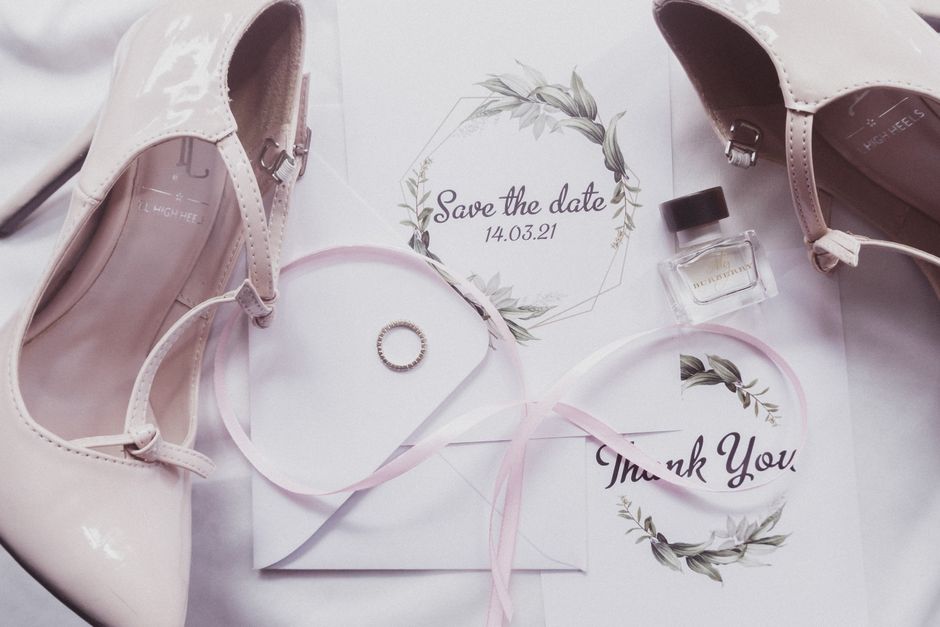
The save the date is one of the few pieces of event stationery that does nothing except ask for a calendar entry. There is no reply card, no menu selection, no dress code line. Its only job is to arrive early enough that a guest can protect a date before the rest of life fills it in.
That simplicity makes the format easy to underestimate, but it also explains why it survived the move from letterpress to email and from mailboxes to social feeds. Tracing the history of save the date cards shows a piece of paper that kept only the parts guests actually needed, then changed shape as the way people communicate changed.
Early Wedding Mail Set the Pattern
Long before anyone used the term save the date, wedding mail already carried many of the elements modern couples recognize. One invitation archive opens with a card from 1900, inviting guests to a marriage in Massachusetts, and it contains many of the parts of a modern wedding invitation.
Notice periods were shorter than they are today. Emily Post's 1922 book Etiquette remains a popular and regularly updated handbook, and Post and the etiquette writers who followed her advised hosts to give guests plenty of notice. The average timed invitation in her era went out about three weeks before the event. Three weeks is not much time to arrange travel, and that gap is where the save the date eventually grew.
When Save the Dates Became a Formal Concept
Save the date cards began to emerge as a formal concept when couples started planning destination weddings or weddings during busy seasons. Both situations created the same problem. A guest who only learns the date three weeks out may already have booked a flight, accepted another invitation, or used up limited vacation days.
The early version of the card answered that problem directly. It went out well ahead of the invitation, announced the date, and asked guests to keep it open.
The Mid-2000s Boom
Save the date cards became popular in the mid-2000s and have taken off in recent years. During that period the cards were still doing very little. As one stationery writer put it, they do little more than announce the date of the event, which is exactly what made them useful and easy to produce.
The rise of the format is also visible in the questions people ask about it. Wedding forums filled with threads from guests and couples trying to work out the difference between a save the date and a wedding invitation, and asking whether the two pieces of mail serve the same purpose. That confusion is a sign of how recently the save the date became a standard step rather than a novelty.
What the Phrase Itself Means
The term comes from the verbal phrase itself, an instruction that recipients should reserve the date in their calendars. The wording is plain because the function is plain. Nothing about the phrase promises an invitation, a seat, or a plus-one. It promises information and a request for patience.
That distinction matters for anyone drafting one. A save the date that reads like an invitation creates expectations the real invitation then has to correct. A save the date that reads like a note to hold the date does its job and gets out of the way.
Save the Date Versus the Wedding Invitation
The two pieces of mail are often confused, but they are not interchangeable. The clearest way to separate them is by what each one asks of the person holding it.
| Element | Save the date | Wedding invitation |
|---|---|---|
| Main purpose | Announces the date and asks guests to keep it open | Provides the full details and requests a response |
| Message to the guest | Invitations are on the way soon, keep the date saved until then | Here is everything needed to attend and reply |
| Typical timing | Sent well ahead, commonly 6 to 8 months before the wedding | Follows the save the date as the event approaches |
| Level of detail | Little more than the date | Full detail for the event |
How the 6 to 8 Month Window Became Standard
Current etiquette guidance suggests save the dates go out 6 to 8 months before a wedding. That window gives guests time to plan travel, request time off work, and budget for the trip, all of which take longer than choosing an outfit. For destination weddings and holiday weekend celebrations the reason is obvious. For local weddings the same window simply removes a source of stress.
Timing is guidance rather than law, and it shifts with the size of the guest list and how far people are traveling. Anyone working to a fixed date should confirm the details with their venue and their own planner instead of treating a general rule as a deadline. The useful principle is the one Post's era already pointed to. Notice is a courtesy, and more of it is rarely a problem.
The Move From Paper to Digital
Printing and postage can account for a large share of a stationery budget, and that cost is one reason digital save the dates gained ground. A card that exists as an image or a link can reach hundreds of people without a print run, and it can be corrected if a detail shifts.
Etiquette writing now covers the best ways to send save the dates in a digital age, which shows how settled the digital option has become. Email, messaging apps, and social platforms all deliver the same short message the paper card delivered, which is to hold this date. For events that are not weddings, including conferences, reunions, and community gatherings, a digital save the date is often the only format that makes sense, because the audience is already gathered in one online place.
The digital version also changed the follow-through. A paper card ends the conversation until the invitation arrives. A digital one can point straight to a page with the date and a way to reply, which shortens the distance between the announcement and the guest's decision. That shift is what makes this a story about function rather than format. The paper version and the digital version share the same single job.
What the Paper Era Still Teaches Digital Senders
Three habits carried over from print. Send early, keep the message short, and make the next step obvious.
- Send early enough that guests can act on the date before other commitments fill the calendar.
- Keep the message to the date and the request to hold it, since a save the date that contains everything becomes an invitation without the reply mechanism.
- Tell people what happens next, so they know a formal invitation or registration is coming.
Those habits explain why the format outlasted the printing stage of its life. A digital card that breaks all three is harder to act on than a piece of paper that follows them.

After the Date Is Saved
Once the save the date is out, the work moves to the event itself. Organizers who send their announcement digitally often keep the rest of the process in the same place, and platforms built for that purpose combine the pieces. Eventweet, a mobile-first event discovery and creation platform, brings event pages, AI assisted copy for descriptions and promotional material, social media integrations, and RSVP tracking into one tool, which means a guest who saves the date can be guided straight into a reply. Letterpress or link, the goal after the save the date is unchanged. Fill the room with people who knew about it in time.
Frequently Asked Questions
When did save the dates become popular?
Save the date cards became popular in the mid-2000s and have taken off further in recent years. Before that they were mostly used for destination weddings or celebrations that fell on a busy holiday weekend. As travel became more common and guest lists spread across longer distances, the extra notice a save the date provides turned it from an optional extra into a routine step.
How far in advance should a save the date be sent?
Current guidance suggests sending save the dates 6 to 8 months before a wedding, which gives guests time to plan travel, request time off, and budget. Destination weddings and holiday weekends often call for earlier notice. Timing is a guideline rather than a fixed rule, so confirm any firm dates with your venue and planner before you print or send anything.
What is the difference between a save the date and a wedding invitation?
A save the date announces the date and asks guests to keep it open, and it usually contains little more than that. The wedding invitation follows later with the full details and a request for a reply. In practice, the save the date says that invitations are on the way soon, while the invitation is the piece guests respond to.
Do non-wedding events use save the dates?
They can. The same logic that makes a save the date useful for a wedding applies to any event with a fixed date and guests who need to plan ahead, including conferences, reunions, and community gatherings. Digital formats have made this easier, since a single image or link can reach a large guest list without printing or postage costs.
What should a save the date include?
Keep it minimal. The date is the essential element, and the message should make clear that a formal invitation or registration details will follow. Anything more starts to blur the line between a save the date and an invitation. For events where the location is settled early, adding it can help guests estimate travel, but it is not required.